I2C controlled 1-cell, 1.5-A, battery charger with 20-mA termination | RTW | 24 | -40 to 85
Texas Instruments
 RSS
Sample
RSS
Sample
- Darmowa próbka
- MPN:
- BQ25619ERTWR
- Producent:
- TEXAS INSTRUMENTS
- Dodany do bazy:
- Ostatnio widziany:
Sugerowane produkty dla bq25618
The BQ25618E/619E integrates charge
and voltage protection in a single device. It offers low termination current for switching
chargers to charge wearable devices to full battery capacity. The BQ25618E/BQ25619E low
quiescent current reduces battery leakage down to 7µA in Ship Mode, which conserves
battery energy to extend the shelf life for the device. The BQ25619E is in a 4mm x 4mm QFN
package for easy layout. The BQ25618E is in a 2.0mm x 2.4mm WCSP package for space-limited
designs.
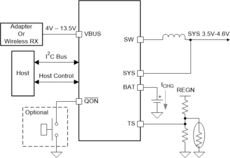
The BQ25618E/619E is a highly integrated 1.5A switch-mode battery charge
management and system power path management device for Li-ion and Li-polymer
battery. It features fast charging with high input voltage support for a wide range
of applications including earbuds (True Wireless or TWS), earphone charging case,
and wearables. Its low impedance power path optimizes switch-mode operation
efficiency, reduces battery charging time, and extends battery run time during
discharging phase. Its input voltage and current regulation, low termination
current,and battery
remote sensing deliver maximum charging power to the battery. The solution
is highly integrated with input reverse-blocking FET (RBFET, Q1), high-side
switching FET (HSFET, Q2), low-side switching FET (LSFET, Q3), and battery FET
(BATFET, Q4) between system and battery. It also integrates the bootstrap diode for
the high-side gate drive for simplified system design. The I2C serial
interface with charging and system settings makes the device a truly flexible solution.
The device supports a wide range of
input sources, including standard USB host port, USB charging port, USB compliant
high voltage adapter and wireless power. It is compliant with USB 2.0 and USB 3.0
power spec with input current and voltage regulation. The device takes the result from the detection circuit in the system, such as
USB PHY device.
The power path management regulates the system
slightly above battery voltage but does not drop below 3.5V minimum system voltage
(programmable) with adapter
applied. With this feature, the system maintains operation even when the battery is
completely depleted or removed. When the input current limit or voltage limit is
reached, the power path management automatically reduces the charge current. As the
system load continues to increase, the battery starts to discharge the battery until
the system power requirement is met. This supplement mode prevents overloading the
input source.
The device initiates and completes a
charging cycle without software control. It senses the battery voltage and charges
the battery in three phases: pre-conditioning, constant current and constant
voltage. At the end of the charging cycle, the charger automatically terminates when
the charge current is below a preset limit and the battery voltage is higher than
the recharge threshold. If the fully charged battery falls below the recharge
threshold, the charger automatically starts another charging cycle.
The charger provides various safety
features for battery charging and system operations, including battery negative
temperature coefficient thermistor monitoring, charging safety timer and overvoltage
and over-current protections. Thermal regulation reduces charge current when the
junction temperature exceeds 110°C. The status register reports the charging status and any fault conditions. With I2C, the VBUSGD bit indicates if a good power source is
present, and the INT output immediately notifies host when
a fault occurs.
The device also provides the
QON pin for BATFET enable and reset control to exit low
power ship mode or full system reset function.
The BQ25619E device is available in a
24-pin, 4mm × 4mm x 0.75mm thin WQFN package.
The BQ25618E is available in a 30-ball, 2.0mm x 2.4mm WCSP package.
Elecena nie prowadzi sprzedaży elementów elektronicznych, ani w niej nie pośredniczy.
Produkt pochodzi z oferty sklepu Texas Instruments